

Sourced from regulators, general information only
· by the mCallz team
mCallz: Are Auto Dialers Legal? Calling Rules by Country, With Sources
Are auto dialers legal? Owning and using one is lawful in most countries; the law governs the calls it places: who receives them, with what consent, at what hour and whether a recording does the talking. mCallz is a dialer that a person drives, ringing one number at a time from the caller's own SIM, with a human on every call and no recorded messages.
- Rules from TRAI, the FCC, the ICO, Canada's DNCL and Australia's ACMA register
- Why a person-driven dialer, a predictive dialer and a robocall are treated differently
- A pre-dial checklist, with every source linked and dated
Calls go out on each phone's own SIM. Dialer, CRM and WhatsApp for ₹4,000 per user a year (₹333/month), down to ₹208/month for bigger teams. GST extra.
- Works on the SIM in each phone
- Android, iPhone and web
- Free trial at app.mcallz.com
The short answer
Are auto dialers legal?
Usually yes: the dialing software is lawful, but consent, do-not-call registers, calling hours and recorded-voice rules decide whether each call it places is lawful.
mCallz is an auto dialer built around a live caller: it rings one number from a list, waits for the person holding the phone to finish the conversation and save an outcome, then moves to the next number. It never plays a recording and never rings several lines at once, which keeps it away from the two practices regulators target hardest, robocalls and abandoned predictive calls. That design does not settle the legal question by itself. India's TCCCPR text defines an auto dialer call as one placed automatically from a stored list that either plays a message or connects to a live person, the FCC's rules require prior express written consent for autodialed telemarketing calls to mobile numbers, and the UK and Australia expect lists to be screened against national registers. Every rule on this page was read on the regulator's own site on 20 October 2026. This is general information, not legal advice.
- The tool is rarely the problem; the list and the consent behind it usually are.
- Recorded messages and dropped predictive calls face the strictest rules everywhere covered here.
- Each country runs its own do-not-call register, and you must check the ones you call into.
Benefits
Auto dialer laws: what checking them first protects
Your phone numbers
In India, repeated complaints can bar a sender's outgoing calls and then disconnect every connection it holds.
Your brand
People who asked not to be called and still get rung remember the company name, and complain about it.
Cleaner lists
Screening against registers and recording opt-outs removes numbers that would never have bought anyway.
Calmer callers
Staff who know the list is consented and screened spend less of the shift apologising.
Fewer surprises abroad
Calling hours and register rules differ by country, so a team calling overseas needs each set in writing.
Three kinds of dialing
Are auto dialers illegal? It depends on what the dialer does
Regulators rarely ban software by name. They write rules about behaviour: dialing from stored lists, playing recordings, and calls answered with nobody on the line. That is why three products sold as "auto dialers" sit in very different legal positions.
Person-driven list dialer
Rings one number from a list, connects the caller, and moves on only when that call ends. Nobody is left waiting in silence. This is how mCallz works. It still dials from a stored list, so consent and register rules still apply to every call.
Predictive dialer
Rings several numbers at once and passes whoever answers to a free agent. When no agent is free, the answered call is dropped or held. US rules cap these abandoned calls at 3% of live-answered telemarketing calls per campaign, and India bars registered senders from dialers that cause silent or abandoned calls.
Robocall or voice broadcast
Plays an artificial or prerecorded voice with no human speaking on the calling side. The UK needs specific consent to automated marketing calls, the US needs prior express written consent for prerecorded telemarketing calls to mobiles, and India's 2025 amendments require disclosure of robo call use.
Click to call or manual dialing
A person picks the number and starts the call. Fewer autodialer rules apply, but do-not-call registers, calling hours and identification rules cover telemarketing however the number was dialled.
India
Auto dialer laws in India: TRAI, DND preferences and the 140 series
India regulates sales calls through TRAI's Telecom Commercial Communications Customer Preference Regulations, 2018 (TCCCPR), amended in February 2025. Customers set preferences for which categories of commercial calls and messages they accept, on which days and in which time bands, by calling or texting 1909, through an app or on a web portal. This is the system most people call DND.
The regulation's own definition matters for anyone choosing software. An "Auto Dialer Call" is a call started automatically by equipment from a stored or generated list which, once answered, either plays a recorded message or connects the call to a live person. A dialer with a person on the line can therefore still be an auto dialer under Indian rules. Registered senders must not run auto dialers that produce silent or abandoned calls, and must tell their telecom provider in advance that they use one.
The 2025 amendments tightened things further. Promotional calls stay on the 140 number series, transactional and service calls move to a new 1600 series, and ordinary 10-digit numbers are restricted for telemarketing. Consent given to complete an ongoing transaction lasts only 7 days, and a business may not ask again for consent within 90 days of a customer opting out. Customers can now complain within 7 days of a spam call, even without having set a preference first.
Penalties fall on the phone connections. After a first violation of the complaint threshold, a sender's outgoing services are barred for 15 days; repeat offenders lose every telecom connection across all providers for a year and are blacklisted. An August 2024 direction had already stopped promotional voice calls from unregistered senders on SIP and PRI lines. The practical reading for a business calling from staff SIMs: call people who enquired or are customers, keep consent records, and run promotional campaigns to cold lists through a registered telemarketer instead.
United States
Is auto dialing illegal in the US? The FCC rules under the TCPA
In the United States, the Federal Communications Commission writes the rules under the Telephone Consumer Protection Act, published as 47 CFR 64.1200. Auto dialing is not banned, but consent requirements depend on the kind of call. A call to a mobile number made with an autodialer or an artificial or prerecorded voice needs the called person's prior express consent, and when that call is telemarketing it needs prior express written consent.
The FCC rule text defines an autodialer as equipment able to store or produce numbers using a random or sequential number generator and to dial them. Whether a particular app meets that definition is a legal question for a US lawyer, so the safer course for sales calls to mobiles is to hold written consent regardless.
Other rules apply to telemarketing whatever dialer you use. Calls to residential subscribers are allowed only between 8 a.m. and 9 p.m. in the called person's local time. Numbers on the National Do Not Call Registry are off limits without an exemption, and those registrations never lapse unless cancelled. Every telemarketer also keeps its own do-not-call list with a written policy and trained staff, and must honour a request within 10 business days. Callers have to give their own name, the business they call for and a contact number or address.
For dialing behaviour, the same section says not to hang up an unanswered telemarketing call before 15 seconds or four rings, and to keep abandoned calls at or below 3% of those answered by a live person over each 30-day campaign. A call counts as abandoned when no live agent is on the line within two seconds of the greeting.
United Kingdom
Auto dialer rules in the UK: PECR, the TPS and recorded calls
In the UK, marketing calls fall under the Privacy and Electronic Communications Regulations (PECR), which the Information Commissioner's Office enforces. Live marketing calls may not go to numbers listed on the Telephone Preference Service (TPS) or the Corporate TPS without that person's specific consent, which means a list has to be screened against both before anyone dials. Anyone who has told you they do not want your calls must not be called again.
Recorded calls face a stricter test. An automated marketing call needs specific consent to automated calls; consent to marketing in general, or to live calls, does not count. Every automated call has to carry your name and a contact address or freephone number. On every call, live or recorded, you must say who is calling and let your number display. Calls about claims management and pensions have extra limits on top.
The TPS describes itself as the only official UK do-not-call register for landlines and mobiles. Registration is free, the ICO enforces the law behind it, and companies can list their numbers on the CTPS. The ICO notes that its PECR guidance is under review after the Data (Use and Access) Act, so check the current page before relying on it.
Canada and Australia
Auto dialer laws in Canada and Australia
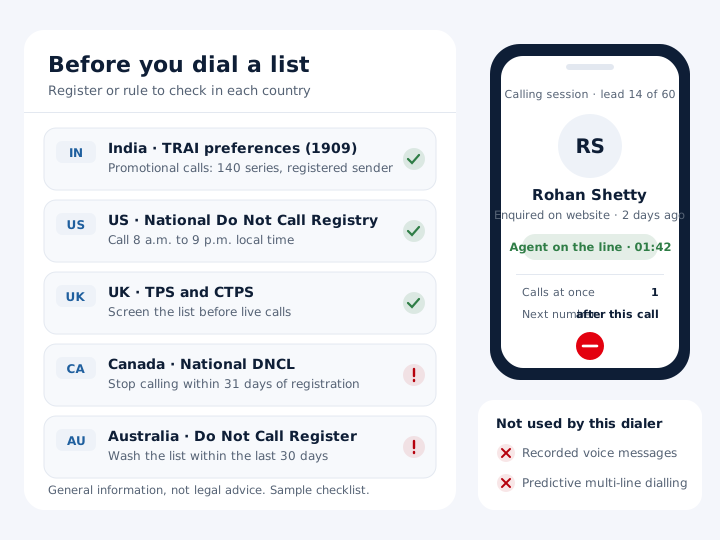
Canada runs the National Do Not Call List, where people can register home, mobile, fax or VoIP numbers for free. Telemarketers have 31 days from a registration to stop calling that number. Calls from registered charities, political parties and candidates, survey firms and newspapers seeking subscriptions are exempt, as are calls to people with an existing business relationship: a purchase or contract in the last 18 months, or an enquiry in the last 6 months. Express consent, written or as recorded verbal agreement, also allows a call, and business-to-business calls fall outside the list entirely.
In Australia, ACMA operates the Do Not Call Register. A registered number may be called only with consent or if the list was washed against the register within the previous 30 days and the number was not on it. Express consent given without a set period lapses after three months. Telemarketing calls are limited to 9am to 8pm on weekdays and 9am to 5pm on Saturdays, with no calls on Sundays or national public holidays unless the person agreed. Caller ID must be switched on, the number shown must accept return calls for 30 days, and the call must end as soon as the person asks.
Before you dial
Auto dialer laws checklist for every calling session
A short routine that covers the common ground across the countries above. It does not replace advice for your market.
Know where each number is
Rules follow the person you call, so sort the list by country and, for the US, by time zone.
Record why you may call
Keep the enquiry form, contract or written consent behind every lead, with its date. India gives transaction consent only 7 days; Australia lets open-ended express consent lapse after three months.
Screen against the register
Wash the list against the national register where you call: TPS and CTPS in the UK, the US federal registry, the DNCL in Canada, the Do Not Call Register in Australia.
Remove your own opt-outs
Anyone who asked not to be called comes off every list, and stays off. Your internal list is a legal requirement in the US and Canada.
Check the clock
Dial only inside the local calling window, for example 8 a.m. to 9 p.m. for US residential lines or 9am to 8pm on Australian weekdays.
Say who you are
Open with your name and company, show your number, and keep a contact number ready for anyone who asks.
Keep a person on the line
Avoid recorded messages and dialers that leave answered calls in silence unless you hold the specific consent and settings the law demands.
How mCallz fits
Auto dialer rules and how the mCallz dialer is built
mCallz was designed for teams calling their own enquiries and customers, and a few design choices line up with the rules above. Its dialer places a single call, waits for the agent to finish talking, and only then moves on, so an answered call always reaches a human. It cannot play recorded messages, and it has no predictive mode that rings extra lines.
Some settings help you follow local rules, provided you set them. The ring limit decides how long an unanswered attempt rings; teams calling US numbers should keep it above the 15-second or four-ring floor. The pause between dialled numbers can be fixed by an admin. Team leads can create an opt-out status of their own and keep those leads out of the filter that feeds each session, while excluded numbers are skipped by backup and by every automation.
What mCallz does not do is just as important. It does not check numbers against any national do-not-call register, it does not register you as a telemarketer anywhere, and it cannot tell you whether your use counts as an autodialer under a given law. Those checks stay with the business. For the dialer's own settings, see the auto dialer app page.
Sources
Auto dialer laws: sources read for this guide
Every rule on this page comes from one of these regulator or government pages, read on 20 October 2026. Rules change; open the source before you act.
- India, TRAI: TCCCPR 2018 overview and the regulation text (PDF), for the auto dialer and robo call definitions, the abandoned-call rule and the limits on unregistered senders.
- India, TRAI: Press Release 11/2025 (12 February 2025) on the TCCCPR amendments: 140 and 1600 series, consent periods, complaint window and penalties.
- India, TRAI: Press Release 51/2024 (13 August 2024) on stopping promotional voice calls from unregistered senders.
- India, TRAI: Customer Preference Registration Facility, for how customers set preferences through 1909.
- United States, FCC rules: 47 CFR 64.1200 on eCFR, for consent, calling hours, do-not-call lists, abandoned calls and the autodialer definition.
- United Kingdom, ICO: Telephone marketing under PECR.
- United Kingdom: Telephone Preference Service.
- Canada: National Do Not Call List and its page on who can still call.
- Australia, ACMA: Do Not Call Register industry standards and using the register.
At a glance
Auto dialer laws by country at a glance
| Country | Register or rule | What it means for a caller | Source |
|---|---|---|---|
| India | TCCCPR 2018, amended 2025; customer preferences via 1909 | Promotional calls on the 140 series from registered senders; no silent or abandoned auto dialer calls; transaction consent lasts 7 days | TRAI |
| United States | TCPA rules, 47 CFR 64.1200; National Do Not Call Registry | Written consent for autodialed or prerecorded telemarketing to mobiles; 8 a.m. to 9 p.m.; at most 3% abandoned calls | eCFR |
| United Kingdom | PECR; TPS and CTPS | Screen live-call lists against TPS and CTPS; specific consent for automated calls; show your number | ICO |
| Canada | National Do Not Call List | Stop calling a registered number within 31 days; exemptions for existing customers and some sectors | DNCL |
| Australia | Do Not Call Register; telemarketing industry standard | Wash lists within 30 days; weekdays 9am to 8pm, Saturday 9am to 5pm, no Sundays or national holidays | ACMA |
Honest limits
Auto dialer laws: what this guide cannot tell you
This page summarises published rules as general information. It is not legal advice, and it has clear gaps:
- Your specific situation. Whether your calls count as telemarketing, service or transactional, and whether your setup is an autodialer in law, depends on facts only a lawyer can weigh.
- Countries not covered. The EU states, the Gulf, Africa and most of Asia have their own rules. Read the regulator's site for every country on your list.
- Rules that have moved since 20 October 2026. The ICO says its guidance is under review, and India changed its regulations in 2025. Check the dated sources above before acting.
- Register screening inside mCallz. The app does not wash numbers against any national register; do that with the official service first, then import the clean list.
- Recorded or predictive campaigns. mCallz offers neither. Teams that need them must find a provider that supports the consent and abandoned-call controls those methods require.
Worked example
Auto dialer laws in India: an example from a Bengaluru loan desk
A home-loan advisory desk in Bengaluru, India. The business is an illustration, not a named customer.
The desk receives about 1,000 home-loan enquiries a month from its own website form, where each visitor ticks a box asking for a call. The form date is saved on every lead, and the advisers run their dialer sessions on fresh enquiries first, so each person is called while the reason for the call is recent.
Anyone who says they no longer want calls gets a "Do not call" status, and the team lead filters those leads out before every session. When the owner wanted to promote a festive interest-rate offer to past customers who had not asked to hear about it, the desk did not use the advisers' SIMs; it booked the campaign through a registered telemarketer on the 140 series. The owner also had a lawyer review the consent wording on the form. The desk and its numbers are an illustration, and none of this is legal advice.
Questions
Auto dialer laws FAQ
Are auto dialers illegal in India?
No, but India regulates how they are used. TRAI's rules define an auto dialer call broadly, bar registered senders from dialers that cause silent or abandoned calls, and expect promotional calls to come from registered senders on the 140 series.
Is auto dialing illegal in the US?
Not in itself. Under the FCC's TCPA rules, autodialed or prerecorded telemarketing calls to mobile numbers need prior express written consent, and do-not-call, calling-hour and abandoned-call rules apply on top.
What are the auto dialer laws in the UK?
Live marketing calls must not reach TPS or CTPS numbers without specific consent, and automated recorded calls need specific consent to that kind of call. Callers must identify themselves and let their number show.
Is a predictive dialer legal?
It can be, within limits. US rules cap abandoned calls at 3% of live-answered telemarketing calls per 30-day campaign, and India bars registered senders from auto dialers that cause silent or abandoned calls.
Are robocalls illegal?
Recorded sales calls are tightly restricted rather than banned outright. The UK needs specific consent to automated calls, and the US needs prior express written consent for prerecorded telemarketing calls to mobile numbers.
What counts as an autodialer under the TCPA?
The FCC's rule text defines it as equipment that can store or produce telephone numbers using a random or sequential number generator and dial them. Whether a specific app qualifies is a question for a US lawyer.
Can I call numbers registered on DND in India?
Only within the preferences and consent that person has given. Customers choose which categories of commercial calls they accept through 1909, and transactional and service calls are treated differently from promotional ones.
What are the legal hours for telemarketing calls?
They vary by country. The US allows residential telemarketing calls from 8 a.m. to 9 p.m. local time, and Australia allows 9am to 8pm on weekdays and 9am to 5pm on Saturdays, with no Sunday calls.
Do I need consent to auto dial people who enquired?
An enquiry usually gives you a reason to call, but its scope and life are limited. India treats consent for an ongoing transaction as valid for 7 days, and Canada counts an enquiry as a business relationship for 6 months.
What happens if a business breaks India's telemarketing rules?
The penalty falls on its phone connections. A first breach of the complaint threshold bars outgoing calls for 15 days, and repeat breaches disconnect every telecom resource for a year and blacklist the sender.
Which auto dialer keeps a real person on every call?
mCallz does. Each call it places is handed to the agent holding the handset before the next starts, it never plays a recording and has no predictive mode, so nobody answers to silence.
Does mCallz make auto dialing legal?
No tool can do that on its own. mCallz is an auto dialer that removes robocalls and abandoned calls by design, but consent, register screening and calling hours remain the business's job in every country it calls.
How much does mCallz cost for a team that dials lists?
Dialling seats are sold by the year, from ₹4,000 per seat (US$44.08) for teams of up to four down to ₹2,500 (US$28.30) when 20 people dial, with bigger teams quoted separately. GST is added, while call minutes stay on each caller's own mobile bill.
Auto dialer rules checked? Start a session with a person on every call
Screen the list, record the consent, then let mCallz ring one number at a time while your team does the talking.