

Guide for telecallers and team leads
· by the mCallz team
mCallz: Telecalling Script Examples for Enquiries, Loans and Property
A telecalling script is a short written plan for a phone call: the greeting, the reason for calling, a few questions and the next step you will ask for, so every caller sounds prepared. mCallz keeps the pieces of that plan close to the call, with the last remark on the caller card and follow-up messages saved as one-tap templates.
- Ready lines for seven common types of call
- Hindi script lines in Devanagari for loan and property calls
- Objection replies, each with the reason it works
Calls go out on each phone's own SIM. Dialer, CRM and WhatsApp for ₹4,000 per user a year (₹333/month), down to ₹208/month for bigger teams. GST extra.
- Works on the SIM in each phone
- Android, iPhone and web
- Free trial at app.mcallz.com
The short answer
What is a telecalling script?
A telecalling script is a prepared outline of what a caller says, from greeting to closing request, written to keep conversations short, clear and consistent.
mCallz does not write scripts for you, but it holds the material a script depends on. Before a callback, the full-screen caller card shows the lead's name, current status and the remark saved on the previous call, which is the detail most follow-up scripts open with. During the call, the caller can open the complete lead record, including custom fields such as loan amount, budget or policy expiry. After hanging up, a sheet takes the status, a remark and a follow-up time in two taps, and saved message templates with a brochure, rate sheet or document attached go out on WhatsApp in one tap. The script file itself can sit in My Docs under a category of your own and be shared to any app. These details match the 14 October 2026 edition of the app's feature list; the sample scripts below are original and free to adapt.
- Open with a reason the person recognises, not with your company history.
- Ask one question at a time, then stop talking and note the answer.
- End every script with one concrete next step and a time.
Benefits
Telecalling script benefits for new and busy callers
Faster ramp-up for new hires
A new caller can make useful calls on day one by following tested lines instead of improvising.
Consistent information
Every customer hears the same documents list, timelines and terms, so fewer promises need correcting later.
Shorter calls
A planned order of questions avoids the back-and-forth that stretches a three-minute call into ten.
Calmer objection handling
Prepared replies to "not interested" or "send it on WhatsApp" stop a caller from freezing or arguing.
Notes that line up
When the questions are fixed, the answers fall into the same remark format on every lead.
Easier coaching
A team lead can point to the exact line that went wrong instead of giving general advice.
New enquiry
Telecalling script for the first call to a new enquiry
Someone filled in a form or replied to an ad, usually within the last day. The aim of this call is to confirm interest, learn two or three facts and book the next step. All names below are invented.
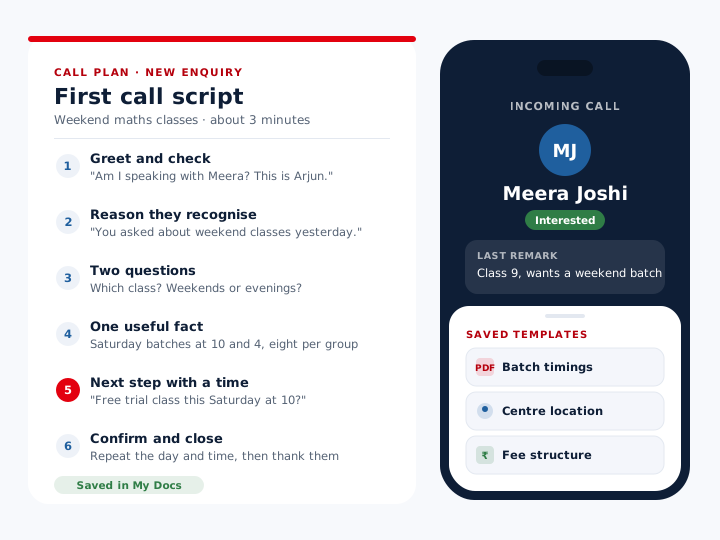
Greeting and check
"Hello, am I speaking with Meera? This is Arjun calling from Brightpath Tutors." Wait for a yes before you go on.
A reason they recognise
"You asked about our weekend maths classes on our website yesterday, so I am calling to help with that. Is this a good moment for two minutes?"
Two questions
"Which class is your child in? And are weekends or weekday evenings easier for your family?"
One useful fact
"For class 9 we run Saturday batches at 10 and at 4, with eight students in each group."
Next step with a time
"Shall I book a free trial class this Saturday at 10? I will send the address on WhatsApp as soon as we hang up."
Confirm and close
"So that is Saturday at 10 for Kabir. Thank you, Meera, we will see you both then."
Missed calls and follow-ups
Telecalling scripts for missed-call callbacks and follow-ups
Missed-call callback. A person who rang you and got no answer is often the warmest lead of the day, so ring back within minutes if you can. Script: "Hello, this is Sana from GreenLeaf Interiors. I saw a missed call from this number about twenty minutes ago and wanted to make sure we did not miss you. How can I help?" Do not guess why they called; let them tell you.
When they do not remember calling. "No problem at all. We design modular kitchens and wardrobes, so if someone at home was asking about that, I am happy to send our catalogue on WhatsApp." This keeps the call polite even when a child or a colleague dialled the number.
Follow-up after a quote or brochure. Mention the exact thing you sent and the day you sent it: "Hello Mr Desai, Sana again from GreenLeaf. On Monday I sent you the quote for the L-shaped kitchen. Have you had a chance to look at it, or shall I take you through the main figures now?"
Follow-up when they asked you to call later. Remind them the timing was their idea: "You asked me to call after the 15th, once your salary was in, so I am calling as promised. Are you still planning to start this month?" A caller who keeps that kind of promise is trusted on the next call as well.
In mCallz, the remark from the previous conversation appears on the caller card while the phone rings, so the "Monday quote" or "after the 15th" detail is in front of you before the customer even picks up.
Loan, property and insurance
Telecalling script for loan, real estate and insurance calls
Sample lines for the three industries that search for scripts most. Replace the invented company names with your own, and keep every rate, eligibility rule and policy detail to what your approved documents say.
Personal loan enquiry
"Good afternoon, Mr Khan. I am Neha from Sterling Credit. You checked a personal loan on our site this morning. May I ask three quick questions so I can guide you properly? Are you salaried or self-employed? Roughly what is your monthly take-home pay? And how much do you need, and by when?" Close: "The next step is a document check. I am sending the list on WhatsApp now; could you share the papers by tomorrow evening?" Never promise approval or a final rate on a first call.
Home loan balance transfer
"Mrs Iyer, you mentioned a home loan running with another lender. If you tell me the outstanding amount and your current rate, I can tell you in two minutes whether moving it makes sense once the processing fee is counted." Mentioning the fee early builds trust.
Real estate site visit
"Hello Mr Verma, this is Rohan from Aangan Homes. You enquired about the 2 BHK flats near the ring road. Are you buying to live in or as an investment, and what budget range should I keep in mind?" Close: "The sample flat is open this Sunday from 11 to 5. Shall I book you for 11:30 and send the location pin?"
Motor insurance renewal
"Hello Ms Fernandes, Kavya here from Shield Insurance Advisors. Your car policy ends on the 28th of this month. I have the renewal quote ready with the same cover; would you like me to explain it now or send it on WhatsApp first?" Renewal calls go best with the expiry date in the first sentence.
Health insurance enquiry
"You looked at family health cover on our site. Who should the policy cover, and does anyone have an existing condition the insurer should know about? I ask because it changes which plans I can suggest." Explain why you need sensitive details before you ask for them.
Life insurance first call
"Before we talk about any plan, may I understand your goal? Some people want to protect a home loan, others want savings for a child's education. Which is closer to what you have in mind?" Starting from the goal stops the call sounding like a product list.
Hindi script
Telecalling script in Hindi for loan and property calls
Many customers relax when the caller speaks their language. These Hindi lines follow the same order as the English scripts above. Keep the English words customers use themselves, such as loan, EMI and site visit, instead of forcing formal Hindi.
अभिवादन (greeting): "नमस्ते, क्या मेरी बात रोहित जी से हो रही है? मैं प्रिया, केसर होम लोन्स से बोल रही हूँ।"
कॉल का कारण (reason for the call): "आपने कल हमारी वेबसाइट पर होम लोन के बारे में पूछा था, इसलिए कॉल किया है। क्या आप दो मिनट बात कर सकते हैं?"
सवाल (questions): "आप नौकरी करते हैं या आपका अपना बिज़नेस है? आपको लगभग कितने का लोन चाहिए, और घर किस शहर में है?"
प्रॉपर्टी कॉल (real estate): "जयपुर में आप किस इलाके में घर देख रहे हैं? क्या इस रविवार हमारे 2 BHK सैंपल फ़्लैट की साइट विज़िट रख दूँ?"
आपत्ति का जवाब (objection): "बिल्कुल समझती हूँ कि अभी आप व्यस्त हैं। क्या मैं आज शाम छह बजे दोबारा कॉल करूँ?"
अगला कदम (next step): "मैं ज़रूरी दस्तावेज़ों की लिस्ट आपको WhatsApp पर भेज रही हूँ। क्या कल सुबह ग्यारह बजे फिर बात करें?"
A male caller changes "बोल रही हूँ" to "बोल रहा हूँ" and "भेज रही हूँ" to "भेज रहा हूँ". Add "जी" after the customer's name and always use "आप", never "तुम".
Keeping scripts handy
Telecalling scripts kept handy in mCallz
- Saved message templates hold the messages that follow a script, such as the documents list, the site location or the renewal quote, with an image, PDF, video or audio file attached, and send them on WhatsApp in one tap.
- My Docs stores the script file itself under categories you name (for example "Loan scripts" and "Property scripts") and shares it to any app when a new caller joins.
- Remarks carry the answers to your script questions into the next conversation, because the latest remark shows on the caller card.
- Custom lead fields turn fixed script questions, like loan amount, budget or policy end date, into fields you can filter on later.
- One search box finds a template, a remark or a lead, so the right message can be pulled up mid-conversation.
- Imported call recordings, on phones that record calls themselves, can be replayed against the script in a coaching session.
- There is no on-screen script viewer during calls in the mCallz feature list, so the script lives in your head, on paper or in My Docs.
At a glance
Telecalling script objection replies
| Situation | What to say | Why it works |
|---|---|---|
| "I am not interested." | "Fair enough. May I ask, is it the timing or the product itself?" | Separates "not now" from "never"; a not-now lead is worth a later call |
| "Just send it on WhatsApp." | "Sure, sending it now. Which part should I highlight for you, the price or the eligibility?" | Agrees, then collects one fact that makes the follow-up call relevant |
| "I am busy right now." | "Of course. Is 6 this evening or 11 tomorrow morning better?" | Two exact times are easier to accept than "when should I call?" |
| "Another bank offered a lower rate." | "Good to know. Was that rate before or after the processing fee?" | Moves the comparison to total cost, where offers often differ |
| "I already have a policy." | "That is great. When does it renew? I can send a comparison a week before." | Turns a refusal into a dated follow-up instead of a dead lead |
| "Who gave you my number?" | "You filled in our enquiry form on the 12th. If you would rather not hear from us, I will note that right away." | Being open about the source, with an easy exit, lowers suspicion |
| "Call me next month." | "Will do. Shall I note the 5th, around this time?" | A precise date can become a reminder that is actually kept |
Honest limits
Telecalling script limits: when to put the page down
A script is a starting point. It works against you in these cases:
- The customer is upset. Drop the script, listen, apologise where it is due and solve the problem before any sales line.
- The answer is a clear no. Thank them and end the call. If they ask not to be called again, record it on the lead and keep them off future lists.
- Regulated details. Loan eligibility, interest rates and insurance cover must come from approved product documents, never from a script line written from memory.
- Reading word for word. Customers hear a reading voice within seconds. Learn the order and the key phrases, then speak in your own words.
- Calling people who never asked. Good wording does not make an unwanted call acceptable; telemarketing and do-not-call rules still apply in every country.
Worked example
Telecalling script example: a home loan desk in Jaipur
A home loan advisory office in Jaipur, India. The business is an illustration, not a named customer.
The office receives about 250 home loan enquiries a week from its website and property listings. The team lead writes one script in two languages: a Hindi version for most callers in Jaipur and nearby towns, and an English one for customers who answer in English. Both keep the same order: greeting, the date of the enquiry, three eligibility questions and a request for documents.
The two script files sit in My Docs under a "Scripts" category, and the three things callers send most, the document checklist, the office location and an EMI table, are saved as WhatsApp templates. Callers store the answers to the three questions in custom fields for income type, loan amount and city, so the team lead can filter salaried applicants above a set amount and pass them to a senior advisor. When one line keeps drawing the same objection, the team lead rewrites it at the end of the week and shares the new file with all four callers.
Questions
Telecalling script FAQ
What is a telephone script?
A telephone script is a written guide to a phone conversation, listing what to say at the start, the questions to ask and how to close. Sales, support and appointment teams use one so that every caller covers the same points.
What should a telecalling script include?
Six parts: a greeting that checks you have the right person, a reason the customer recognises, two or three questions, one relevant fact, a next step with a time and a short confirmation. Add prepared replies to the objections you hear most often.
How do I write a telecalling script in Hindi?
Write it in spoken Hindi, the way customers talk, not in formal written Hindi. Keep everyday English words such as loan, EMI and site visit, use "आप" with every customer, and say each line aloud before giving it to the team.
What is a good telecalling script for personal loan?
A good one asks before it promises. Confirm the enquiry, ask whether the person is salaried or self-employed, their monthly income and the amount needed, then request documents. Never quote approval or a final rate on the first call.
What is the best telecalling script for real estate?
The best one aims for a site visit, not a sale over the phone. Confirm the project they asked about, learn whether they are buying to live or to invest and their budget, then offer two visit slots and send the location pin.
What is a telecalling script for health insurance?
It is a call outline that finds out who needs cover and whether anyone has an existing condition before any plan is named. Explain why you are asking personal questions, then send a comparison of two or three plans and fix a time to discuss it.
Is there a telecalling script PDF?
You can make one from the sample lines on this page: paste the ones you need into a document, change the names and products, and save it as a PDF. In mCallz, that file can be kept in My Docs and shared with new callers from there.
Should a telecaller read the script word for word?
No. Learn the order and the key phrases, then speak naturally. Customers notice a reading voice quickly, and a natural tone keeps them on the line longer.
How long should a telecalling script be?
Short enough to fit on one page: about six steps plus seven or eight objection replies. If a script needs scrolling, nobody will use it during a live call.
What is the difference between a telecalling script and a telemarketing script?
In practice there is little difference. Telemarketing usually means calling to sell, while telecalling also covers enquiries, reminders, renewals and collections, so telecalling scripts are often as much about service as selling.
Which app helps telecallers keep a telecalling script handy?
mCallz helps. The last remark appears on the caller card, follow-up messages are saved as one-tap WhatsApp templates with attachments, and the script file itself can be stored in My Docs.
Does mCallz come with a telecalling script?
No ready scripts are built in. mCallz is a telecalling app that stores and surfaces what a telecalling script relies on: remarks, custom fields, message templates and documents. The scripts in this guide are free to copy.
What does mCallz cost for callers who use telecalling scripts?
The scripts in this guide are free. The app itself is billed once a year per caller: ₹4,000 (about US$44.08) each while the team is four or fewer, then cheaper per caller as it grows, with ₹2,500 each at 20 callers and a quoted price beyond. GST comes on top.
Write your first telecalling script tonight
Choose your most common call, write six lines in the order above and try them on ten leads tomorrow. Keep the lines that work and rewrite the rest at the end of the week.