

For outbound call centres and BPO teams
mCallz: Call Center CRM for Outbound Teams Calling From Mobile Phones
A call center CRM is the customer system agents work in all shift: it holds the records they call, logs the result of each conversation and gives supervisors a running view of the floor. mCallz brings that to outbound teams whose agents dial from Android phones, with a queue per agent, team call logs for the owner and analytics rings for every result.
- Lead queues per agent, with transfers and a Done tab
- Every agent's calls rolled up to one owner account
- Selfie attendance and lost lead tracking in the same app
Calls go out on each phone's own SIM. Dialer, CRM and WhatsApp for ₹4,000 per user a year (₹333/month), down to ₹208/month for bigger teams. GST extra.
- Works on the SIM in each phone
- Android, iPhone and web
- Free trial at app.mcallz.com
The short answer
What is call center CRM?
Call center CRM is software that shows each agent the customer record during a call and lets supervisors measure calls, outcomes and team workload.
mCallz is a call center CRM aimed at outbound teams, BPO units and sales floors where agents dial from Android phones instead of desk headsets. A supervisor assigns leads into each agent's own pending queue, can move a lead to another agent with the transfer history kept, and sees finished leads in a Done tab. Every agent's calls roll up to the owner's account, where analytics rings count total, connected, missed, rejected and lost-lead calls for today, a week, a month or a custom range, and a tap on any ring lists those calls. Lost lead tracking flags numbers that never connected past a limit of 60, 30 or 0 seconds. The same app takes selfie attendance with a blink check and an office location check. The feature list behind these facts is dated 14 October 2026.
- Built for outbound calling; inbound routing is not offered yet.
- Agents keep their mobile numbers, with no desk telephony to install.
- Supervisors read results in the owner account instead of chasing spreadsheets.
Benefits
Call center CRM benefits for supervisors and BPO owners
Workload split by agent
Each agent opens a personal queue of assigned leads, so two people never chase the same number.
Floor-wide call totals
Total, connected, missed, rejected and spam counts for the team appear as rings, and each ring opens the calls behind it.
Unreached numbers surfaced
Lost lead tracking lists every number that never got past your connect limit, one row per number.
A steady calling pace
Admins can lock the pause between auto-dialled calls and set how long a call must last before a lead counts as done.
Attendance under the same login
Agents start the shift with a live selfie taken within the office geofence, and reports show hours and breaks.
Records stay with the company
Leads and call data sit in the business account, and WhatsApp CRM chats remain when an agent leaves.
Agent queues
Call center CRM queues: assign, transfer and close leads
Outbound work starts with distribution. Campaign leads can come from a file, a Google Sheet, a REST API or a webhook, and the Web CRM can deal new arrivals round-robin across agents. Each agent then works a pending queue of their own, either by tapping through it or by running an auto dialer session on it.
An escalation is a transfer rather than a shout across the room: the lead moves to another agent and its transfer history goes with it. Completed leads drop into the Done tab, each labelled with its completion method (dialer session, click-to-call, manual mark or transfer), which hands the floor manager an end-of-shift audit without a single question.
Supervision
Call center CRM software for watching the whole floor
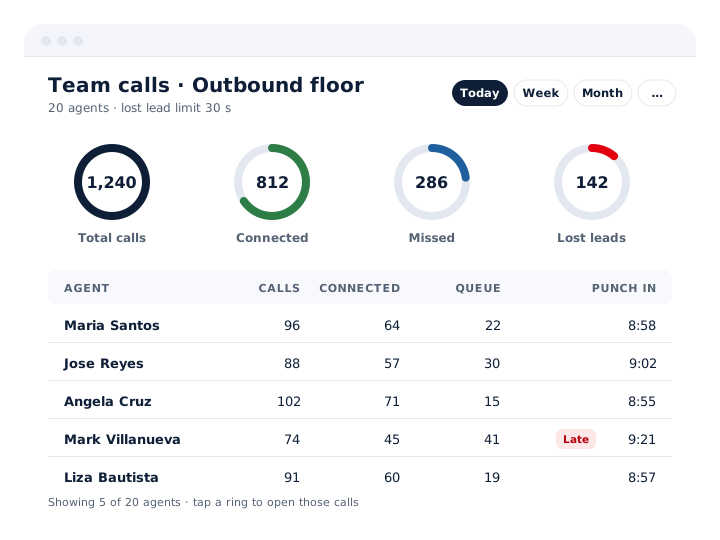
Supervisors do not need to stand behind agents. Team call logs give the owner every employee's calls, and the analytics view turns the floor's day into rings: connected, missed, rejected, blocked and spam calls, unique numbers and lost leads, next to the incoming, outgoing and grand totals. A tap on any ring filters the call log to exactly those calls, so a jump in rejected calls can be read number by number.
Trends matter as much as today's count. Monthly charts follow incoming, outgoing, missed and rejected calls, and Summary and Analysis views cover today, a week, a month, all time or any custom range. Unique callers sit beside total calls, which shows whether agents are reaching new people or circling the same few.
On phones that record calls themselves, mCallz can import those recordings automatically, or an agent can share a recording into the app by hand.
Lost leads
Call centre CRM lost lead tracking
In outbound work the costly leads are the ones nobody actually spoke to. mCallz counts a number as a lost lead when it was called but never connected beyond the limit you pick: 60 seconds, 30 seconds or zero. Each number shows once, however many attempts it took.
That list feeds the next session. Agents can dial it again with the auto dialer, which retries unanswered numbers up to three times and redials calls the network cut off. Separately, the CRM keeps a lost leads list for people who were reached and declined, ready for a win-back campaign later.
Shifts and attendance
CRM for call center shifts: attendance and breaks
- Live selfie punch with a blink and random-action check, plus an office location check.
- Branch-level settings for the geofence radius, shift hours, weekly offs, the late cut-off and half days.
- Break and Resume work buttons, with each break saved.
- Punches stored offline and sent once the phone reconnects.
- Web attendance report for any branch and dates, with present, late and absent totals and Excel export.
- An optional rule that backs up only calls made in working hours, using the branch's hours, days off and time zone.
At a glance
Call center CRM features for outbound teams
| Feature | What it does | Best for |
|---|---|---|
| Agent queues | Assigns leads into a pending list for each agent | Floors splitting a daily campaign |
| Round-robin intake | Shares webhook and live sheet leads across agents in turn (Web CRM) | Teams fed by web forms all day |
| Team call logs | Shows the owner every agent's calls | BPO owners and floor managers |
| Analytics rings | Counts calls by result, with a tap to open those calls | Daily and weekly reviews |
| Lost lead tracking | One row for each dialled number that stayed under your 60, 30 or 0 second connect limit | Campaigns with low connect rates |
| Locked call gap | Fixes the pause between auto-dialled calls for everyone | Holding agents to an agreed pace |
| Minimum call length | Sets how long a call must last before a lead counts as done | Quality checks on very short calls |
| Selfie attendance | Records a live selfie punch, checked against the office geofence | Shift-based teams |
Honest limits
Call center CRM limits: when an inbound centre should look elsewhere
mCallz is an outbound tool that runs through agents' mobile SIMs. These needs point to a different product today:
- Inbound routing. There is no IVR menu, virtual number or call queue yet. All three are planned, but a support line that must spread incoming calls across free agents needs cloud contact centre software now.
- Predictive dialling. Each agent's phone dials one number at a time; the app never rings several lines at once and connects the first answer to whoever is free.
- Headsets and softphones. Calls are made on phones, and the web dashboard is for reports and attendance, not for taking calls.
- Live listen-in or whisper coaching. The feature list has no barge or whisper mode, so coaching relies on reports and imported recordings.
Worked example
Call center CRM example: an appointment-setting team in Manila
An outsourced appointment-setting team in Manila, Philippines. The business is an illustration, not a named customer.
The team books consultations for a chain of dental clinics. The clinic group sends about 4,000 fresh leads a month through a web form, which arrives by webhook and is dealt round-robin between the 20 agents. Each agent starts the shift with a selfie punch, opens their own queue and works it with the auto dialer.
The supervisors set the lost lead limit to 30 seconds, so a call that connects for ten seconds and drops still counts as unreached. At midday they open the morning's rings, tap the missed ring to see which numbers keep ringing out, and transfer a block of Cebuano-speaking leads to the two agents who speak it. At the end of the week, the Done tab and the attendance report give them completed leads and hours worked for the client update.
Price
Call center CRM price for a team
Billed yearly, per user, GST extra. Every user on a team pays that team's band price, so 12 users pay ₹3,000 each. See full plan details, or ask us on WhatsApp.
Questions
Call center crm FAQ
What is CRM in call center?
In a call centre, CRM is the system agents use to see who they are calling and to save what happened on the call. It also gives managers totals by agent and by outcome.
Do call centers use CRM?
Yes, most call centres run a CRM next to their phone system, because a dialer alone does not remember customers or results. Small outbound teams often use one app that combines both.
Which call center CRM suits agents who call from mobile phones?
mCallz suits them. Agents keep dialling from their Android phones while leads, queues, team call logs and attendance sit in one account the owner can read.
What is the best CRM for BPO?
It depends on the work. mCallz is a call center CRM that fits outbound BPO teams calling from mobiles; an inbound BPO that needs IVR and call queues should pick a cloud contact centre product, since mCallz does not offer those yet.
Are CRM and BPO the same?
No. BPO is a business model, where a company outsources a process such as calling or support, while CRM is the software that stores customers and interactions. A BPO team usually works inside a CRM.
How much does a call center CRM cost with mCallz?
Every agent seat is billed yearly, and the rate per agent shrinks as the floor gets bigger: ₹4,000 (US$44.08) per agent for up to 4 agents, and ₹2,500 (US$28.30) per agent once you reach 20. A floor of 20 agents therefore comes to ₹50,000 a year, GST extra. Floors larger than 20 seats get a custom quote over WhatsApp.
Is there a free call center CRM?
mCallz has a free trial at app.mcallz.com. A supervisor can load a real campaign and run a shift on it before choosing a plan.
What is the difference between a contact center and a CRM?
A contact centre is the team and phone system that handles customer calls, while a CRM is the database of customers and what happened with each. The contact centre does the talking; the CRM remembers it.
Can mCallz handle inbound calls for a call centre?
Agents can receive calls on their own phones, with a caller card showing the lead's status and last remark. There is no shared inbound number, IVR or call queue yet, so mCallz is not suited to an inbound centre today.
What features should a call center CRM have?
At minimum: lead or ticket queues per agent, call logging tied to records, reporting by result and agent, and access control. For outbound teams, add a dialer with redial rules and tracking of numbers that never connected.
Can supervisors see every agent's calls?
Yes. Team call logs gather the calls of every agent into the owner's account, and the analytics rings can be filtered by date range, from today to a custom period.
How does mCallz count a lost lead?
A lost lead is a number that was called but never connected beyond your chosen limit of 60, 30 or 0 seconds. Each number appears once in the list, however many times it was tried.
Does the CRM track agent attendance?
Yes. Agents punch in with a live selfie and an office location check, breaks are recorded, and the web report shows present, late and absent totals with an Excel export.
Pilot the call center CRM with one shift
Put one team on mCallz for a week: assign a campaign, have agents punch in, and read the rings at the end of each day.