

Guide for telecalling teams
· by the mCallz team
mCallz: Telecalling Tips for Callers, Beginners and Team Leads
Telecalling tips are practical habits and rules that help a phone caller reach more people, hold better conversations and keep every promised callback. mCallz turns several of them into settings, such as redial rules, ring limits and follow-ups that ring like alarms.
- Preparation and timing tips for the start of a shift
- No-answer, remark and follow-up rules that keep leads alive
- Daily targets a team lead can set and check fairly
Calls go out on each phone's own SIM. Dialer, CRM and WhatsApp for ₹4,000 per user a year (₹333/month), down to ₹208/month for bigger teams. GST extra.
- Works on the SIM in each phone
- Android, iPhone and web
- Free trial at app.mcallz.com
The short answer
What are the most useful telecalling tips?
The most useful telecalling tips: prepare before dialling, call at sensible hours, record clear notes, retry unanswered numbers on a schedule and keep every callback.
mCallz is a calling app that builds several of these telecalling tips into the phone itself. Unanswered numbers can be redialled one to three times, straight away, after a delay you pick or after the whole list, while a ring limit ends each attempt before it wastes time on a switched-off phone. Calls the network cuts before they ring are tried again up to two times without anyone tapping. Follow-ups are set from presets between 5 minutes and 1 month, ring like an alarm even after a restart, and stay open until someone marks them done. For team leads, team call logs and analytics rings show connected, missed and lost-lead calls per person, and calls below a minimum length you set never mark a lead as done. Every one of these settings appears in the 14 October 2026 feature list.
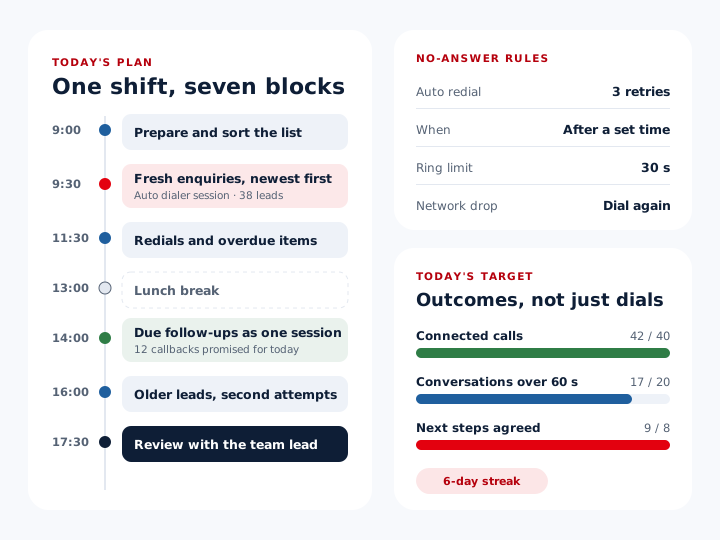
- Plan the shift in blocks before the first call.
- Treat every unanswered number as a task with a next attempt.
- Measure conversations and next steps, not just dials.
Benefits
Telecalling tips benefits for callers and team leads
More people reached
Spaced retries and better call times connect with leads that a single attempt would lose.
Calmer evenings
A planned shift means no pile of unlogged calls and forgotten callbacks at closing time.
Notes anyone can use
A fixed remark pattern lets a colleague take over a lead without ringing the customer to ask again.
Fairer targets
Targets built on connected calls and next steps reward good work rather than fast dialling.
Quicker progress for beginners
Clear routines give new callers something solid to follow while their confidence grows.
Before the first call
Telecalling tips for preparing before you dial
- Know three facts by heart: the price or price range, how long delivery or processing takes, and what the customer has to provide. Most questions on a call are one of these.
- Check where today's leads came from. Someone who filled in a social media form expects a different opening from a walk-in or a referral, and source tags show this at a glance.
- Sort the list before dialling, newest enquiries first, because interest fades within hours of a form being filled in.
- Charge the phone, test the earphones and find a quiet corner. A dropped call or a noisy room costs more than the five minutes these checks take.
- Have the messages you send most, such as the brochure or the price list, ready as saved templates so they go out while the customer is still on the line.
- Keep water nearby, and stand up for the first few calls if your energy is low; it shows in your voice.
When to call
Telecalling tips on the best times to call
There is no single best hour, but a few patterns hold in most countries. Shop and business owners are easier to reach mid-morning, after the opening rush, and again in the late afternoon. Salaried people answer personal calls more often at lunch and in the early evening. Very early mornings, late nights and public or religious holidays are poor choices, and in some places they also break calling rules.
When a customer names a time, that beats any general rule. Set the follow-up for that exact time and write their words into the remark, for example "after 7, kids asleep by then".
If your list covers several countries, check the local time before each session. Splitting the list by country and working each part in its own session means nobody is woken at dawn.
Above all, study your own results for a few weeks. mCallz can show calls for any date range you pick as well as today, this week or this month, and comparing connected calls across different days and shifts tells you more than any article can.
When nobody picks up
Telecalling tips for handling no-answers
- Space out your attempts. Three calls in five minutes feel like pressure; three calls spread across a morning, an afternoon and the next day feel like persistence.
- Use a ring limit. Letting a phone ring for a full minute rarely helps. In mCallz the ring limit ends the attempt and the redial rules bring the number back later.
- Retry by rule, not from memory. Auto redial gives each unanswered number up to three more tries, and one-number redial covers a single important lead with the tries and gap you choose.
- Send one short message after a missed attempt, such as "Hi, this is Asha from Maji Safi Purifiers about your enquiry. When is a good time to call?" As a saved template, it takes one tap.
- Decide when to stop. After the agreed number of attempts, mark the lead honestly. mCallz lists numbers that never got beyond the threshold you pick (60, 30 or 0 seconds) as lost leads, which can become a win-back list later.
- Return missed incoming calls quickly. The missed-call notification carries a call-back button, so a customer who rang you hears back within minutes rather than hours.
Notes after each call
Telecalling tips for writing remarks that help the next call
A remark such as "interested, call later" helps nobody. Use a short fixed pattern so every note answers the same four questions: what they need, by when, what is stopping them, and what you agreed.
Example: "Needs 2 purifiers, shop and home. Wants them before 1 March. Worried about filter cost. Agreed: send filter price list, call Thu 4 pm." It takes about fifteen seconds with voice input and saves a whole call later.
Let the status carry the stage and the remark carry the story. Tags work best for facts you will filter on, such as product or language, so you can later call everyone tagged with one product in a single session.
Write figures and dates exactly as the customer said them. "Budget about 300,000 shillings" is useful; "budget OK" is not.
Keeping promises
Telecalling tips for follow-up discipline
Fill the follow-up field every time
The after-call sheet asks for it, so make it a team rule that no call is saved without either a time or a reason there is none.
Choose realistic times
Use the preset nearest to what the customer said, from 5 minutes to 1 month, or a custom date for answers like "after payday".
Clear overdue items before lunch
Anything you missed shows as overdue and lands in Today. Deal with each item by noon, either by calling or by rescheduling with a reason.
Close the loop properly
Press Mark done only when the promise is kept, or switch on "Complete after a call" so a connected call closes the reminder by itself.
Group callbacks into one session
Today's due follow-ups can be auto-dialled together at a fixed hour, which is easier than scattering them through the day.
For team leads
Telecalling sales tips: daily targets that are fair
Dial counts are easy to measure and easy to game. A better daily target mixes three numbers: connected calls, real conversations and next steps agreed, whether a visit, a demo, a document request or a sale.
In mCallz, a lead is marked done only after a call at least as long as the minimum you set, so a five-second call does not inflate the total. The admin can also lock the gap between auto-dialled calls, which keeps the pace comparable across the team.
Set targets per list, not only per person. Yesterday's enquiries will connect far more often than a six-month-old list, so the same target on both is unfair to whoever gets the old one.
Review the day with the caller, not about them. Open the Done tab and the analytics rings together, pick two calls that went well and one that did not, and agree one change for tomorrow. Streaks in Achievements are a light way to recognise steady effort.
First weeks
Telecalling tips for beginners
- Sit with an experienced caller for a morning before your first call, and write down three lines they use that you like.
- Start with warm leads, such as people who enquired this week, before touching any old list.
- Speak a little slower than feels natural. Nerves make most beginners rush, and customers stop listening when they cannot follow.
- Use the customer's name once at the start and once at the close; more than that sounds rehearsed.
- Expect refusals. Most calls will not end in a yes, and that is normal; judge your day by the next steps you set.
- Ask your team lead for one piece of feedback each day rather than a long review once a month.
- When a feature confuses you, check the in-app video guides or ask the Ask AI help assistant after the call, not in the middle of it.
At a glance
Telecalling tips glossary: terms team leads use
| Term | What it means | Where you see it |
|---|---|---|
| Connected call | A call the customer answered, whatever its length | Analytics rings and the call log filter |
| Lost lead | A number called that never connected past the set limit | Lost leads list, with a 60, 30 or 0 second limit |
| Ring limit | How long an unanswered attempt rings before it ends | Auto dialer settings |
| Redial | Another attempt at a number that did not answer | Auto redial (1 to 3 retries) or one-number redial |
| Follow-up | An agreed time to contact the lead again | After-call sheet and the Reminders tab |
| Overdue | A follow-up whose time passed before it was marked done | The Today list in Reminders |
| Done | A worked lead, with how it was completed | Done tab |
| Remark | The note saved after a call | Caller card on the next call, and the lead history |
Honest limits
Telecalling tips limits: what habits cannot fix
Good habits lift results, but some problems need a different fix:
- A list of people who never asked. Old or bought lists connect poorly however well you call, and some numbers may be on do-not-call registers.
- The wrong offer. If the price or product does not suit the people being called, more calls will not change the answer.
- Targets set too high. Callers pushed only on dial counts cut conversations short. Fix the target before blaming the caller.
- Heavy inbound volume. Outbound habits will not help a team swamped by incoming calls; that needs call routing, and mCallz has no IVR or call queues today.
Worked example
Telecalling tips in action: a new caller's first two weeks in Dar es Salaam
A water purifier distributor in Dar es Salaam, Tanzania. The business is an illustration, not a named customer.
Asha joins a team of four telecallers who follow up enquiries for home and shop water purifiers. On her first morning she sits with a senior caller, notes three opening lines she likes, and learns the three figures customers ask about most: the purifier price, the filter price and the installation time.
Her team lead sets the dialer to redial unanswered numbers three times, spaced through the day, with a ring limit so switched-off phones do not hold her up. Asha speaks every remark in the need, deadline, blocker and agreement pattern. Her daily target is not a dial count but connected calls, conversations above the minimum call length and next steps such as an installation visit. At the end of her second week the team lead goes through her Done tab with her, replays one call imported from the phone's own recordings, and agrees a single change: ask whether the purifier is for a shop or a home before quoting a price.
Questions
Telecalling tips FAQ
How can I improve my telecalling skills?
Review a few of your own calls each week and compare them with a colleague who gets better results. Change one thing at a time, such as your opening line or the order of your questions, and watch whether your next steps go up.
How to improve telecalling sales?
Call fresh enquiries first, ask about the need before quoting a price and always agree a next step. Keeping follow-ups on time matters most, because many customers are not ready to decide on the first call.
How many calls should a telecaller make in a day?
There is no single right number; it depends on the list and the product. Warm, recent enquiries allow more conversations per hour than old lists, so set targets on connected calls and next steps and let the dial count follow.
What is a telecaller target?
A telecaller target is the daily or monthly goal a caller is measured against, such as connected calls, appointments booked or sales closed. Good targets combine activity with outcomes so that speed alone is not rewarded.
What is the best time to make telecalling calls?
For business owners, mid-morning and late afternoon usually work; for salaried people, lunch and early evening. The best time for any single lead is the one they asked for, so record it and set a follow-up.
How many times should I call a lead who does not answer?
Three or four attempts spread over two or three days is a common rule, with a short message after a missed attempt. In mCallz, auto redial can try a number one to three more times on the schedule you choose.
What should I write in a call remark?
Write what the customer needs, by when, what is holding them back and what you agreed next. Use their own figures and dates, and keep it to one or two lines.
What should a beginner telecaller do on the first day?
Listen to an experienced colleague before calling, learn the three facts customers ask about most and start with warm enquiries. Speak slowly and aim for clear next steps rather than a large number of calls.
How do I stay motivated as a telecaller?
Judge your day by conversations and next steps instead of refusals, take a short break every hour and notice small wins. In mCallz, streaks and shareable daily cards make steady effort visible.
How can a team lead check telecalling quality?
Look beyond call counts. Read a sample of remarks, compare connected calls with next steps agreed and listen to a few recordings together with the caller. Team call logs in mCallz put every caller's calls in one owner account.
Which app helps telecallers follow these telecalling tips?
mCallz helps. It redials unanswered numbers, rings follow-ups like an alarm until they are done, shows the last remark when a lead calls and gives team leads each caller's connected and lost-lead calls.
Does mCallz build telecalling tips into the app?
Yes, several of them. mCallz is a telecalling app in which redial rules, ring limits, a minimum call length and alarm follow-ups turn these telecalling tips into settings instead of things a caller must remember.
How much does mCallz cost for a telecalling team?
It is paid yearly per caller, and the size of the team sets the rate for everyone on it: ₹4,000 for 1 to 4 users, ₹3,500 for 5 to 9 users, ₹3,000 for 10 to 19 users, ₹2,500 for 20 users. In monthly terms that is ₹333 down to ₹208 a caller. Teams above 20 get a quote, and GST is added.
Pick three telecalling tips for tomorrow's shift
Choose one preparation habit, one no-answer rule and one remark pattern. Use them for a week, then check whether your next steps went up.